RME Babyface Pro FS Review: Is It Worth the Premium Price?
- Audio Interface, Reviews
- by Bruno Bontempo
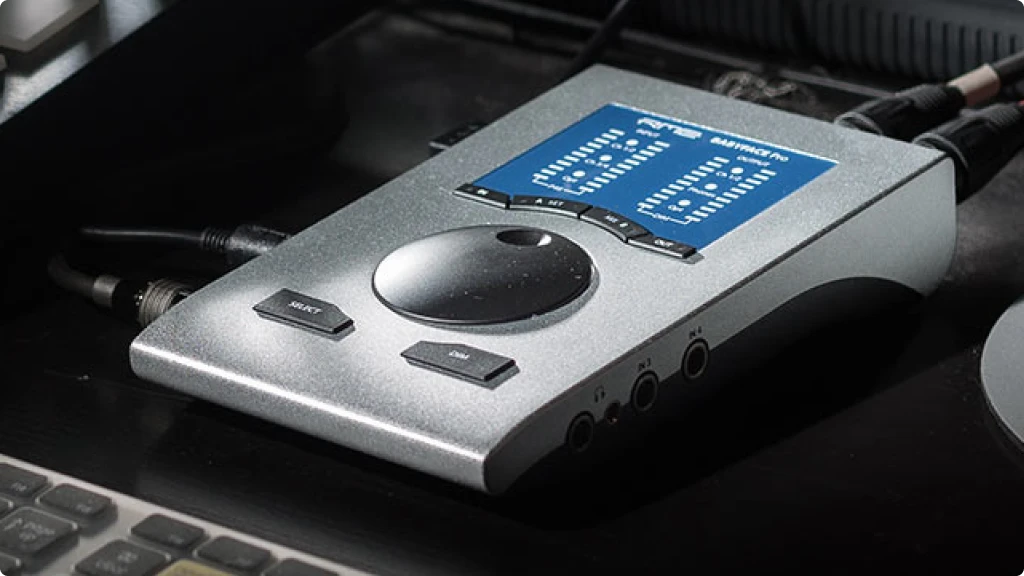
Our articles may include affiliate links and we may earn a commission. Here how it works.
OUR VERDICT
If you are serious about stable performance, ultra-low latency, and advanced routing, the RME Babyface Pro FS is simply a must-have. You invest in German engineering here, and the payoff is a rock-solid driver that lets you forget about crackles and dropouts, even when your projects get huge.
Consequently, it’s an ideal choice for the dedicated producer or musician who needs reliability on the road or in the studio. If you’re tired of mid-range interfaces causing headaches, check the current price and upgrade your foundation.
Release Date
April 2020
10.8x3.6x18.0cm
4.25x1.4x7.1in
680g
1.50 lbs
| Pros
- Ultra-low latency for real-time monitoring
- Legendary driver stability & rock-solid performance
- Powerful TotalMix FX with zero-CPU DSP effects
- Premium portable build with dual headphone outs
- Scalable via ADAT and DC-coupled for modular
| Cons
- Premium price compared to basic interfaces
- Only two XLR inputs on the unit itself
- TotalMix FX has a significant learning curve
| Key Features
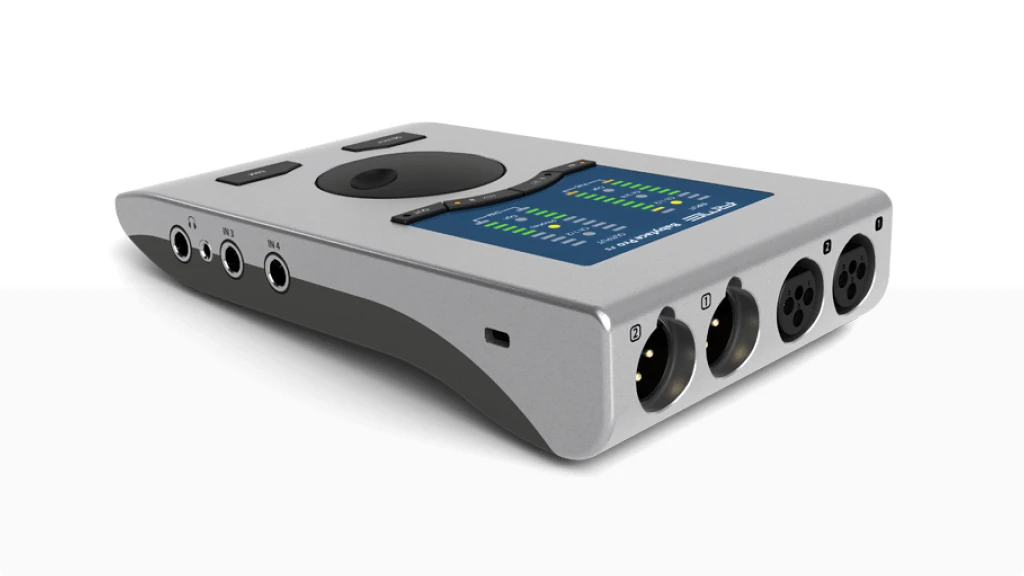
- Inputs: 4 Analog Inputs (2x XLR Mic/Line, 2x 1/4" TRS Line/Instrument); 8 Digital Inputs (ADAT or S/PDIF optical)
- Outputs: 4 Analog Outputs (2x XLR Main, 2x Headphone Outs: 1x 1/4" TRS, 1x 1/8" TRS); 8 Digital Outputs (ADAT or S/PDIF optical)
- Compatibility: Windows, macOS, iOS/iPadOS
- Connectivity: USB 2.0 (compatible with USB 3.0 and C ports)
- Resolution: 24-bit/192kHz
-
Plus:
SteadyClock FS, TotalMix FX DSP Mixer, DC-coupled outputs
| Best for...
- Professional musicians needing absolute driver stability
- Producers working with complex, high-track-count projects
- Engineers needing ultra-low latency for tracking instruments or virtual synths
- Users who want to expand their system using ADAT
- Electronic music creators utilizing modular synths (thanks to DC-coupled outputs)
| Not ideal for...
- Beginners looking for a simple plug-and-play experience (TotalMix FX has a learning curve)
- Users prioritizing a high number of XLR inputs right out of the box (it only has two)
- Budget conscious creators
1. RME Babyface Pro FS Review: Overview
When I first started producing music, I often spent more time troubleshooting my audio interface than actually recording. It’s a common story. You hit ‘record’, and suddenly your track crackles, the audio drops out, or the latency makes playing MIDI keys impossible. German company RME has always built its reputation on eliminating these problems. This RME Babyface Pro FS Review is about a different approach to audio interfaces: prioritizing rock-solid stability.
The Babyface Pro FS is an extremely compact powerhouse designed for the serious creator who needs professional results, no matter where they are. In fact, the “FS” in the name stands for “FemtoSecond,” referring to its super-precise clocking technology, which is a big deal for clean sound.
2. Key RME Babyface Pro FS Features Explained
The Babyface Pro FS packs a surprising amount of engineering into a small aluminum chassis. Most importantly, several features work together to give you a professional studio experience that few other interfaces in this price range can match.
SteadyClock FS Technology
- What it Means for You: This is RME’s latest internal clock, which manages the timing of all the digital audio signals. Think of the clock as the conductor of your digital orchestra. If the conductor is slightly off, the whole performance suffers from something called jitter, which degrades the sound quality. The SteadyClock FS is incredibly accurate, keeping digital timing perfect.
TotalMix FX DSP Mixer
- What it Means for You: TotalMix FX is the digital mixer software that runs inside the interface itself, not on your computer. It gives you complete control over every input and output, allowing for complex routing and zero-latency monitoring with effects. Moreover, you get a 3-band EQ, reverb, and echo built into the unit’s DSP chip.
Ultra-Low Latency Performance
- What it Means for You: RME is famous for having some of the most efficient drivers in the industry. For instance, the measured round-trip latency at a 64-sample buffer size is incredibly low. You can use more plugins, play virtual instruments in real-time, and monitor directly through your DAW without a noticeable delay. Less delay means a smoother, more musical recording experience.
Dual Headphone Outputs
- What it Means for You: The Babyface Pro FS includes two completely separate headphone outputs—a standard 1/4-inch jack and a smaller 1/8-inch jack. Significantly, these outputs have separate, high-quality driver stages. You can confidently use any pair of headphones and know you are hearing the clearest possible signal with ample volume, or you can run two pairs simultaneously for a collaborator.
DC-Coupled Outputs
- What it Means for You: This is a feature most entry-level interfaces skip. DC-coupled outputs allow you to send control voltages (CV) out of the line outputs. If you use analog synthesizers or modular gear, the Babyface Pro FS can send pitch, gate, and modulation signals to them directly from your DAW. This makes your interface a powerful tool for hybrid production setups.
3. Specs Table
| Feature | Specification | Practical Benefit |
|---|---|---|
| Simultaneous I/O | 2×2 | For recording and monitoring |
| XLR Mic Input | 2 XLR/¼" combo input | For mic or instrument like keyboards, synthesizers |
| Hi-Z Inputs | 2 TRS 1/4" combo | For guitars and basses |
| Line/Monitor Outputs | 2 balanced outputs | Connection to studio monitors. |
| Headphone Output | 1/4" Jack | Independent volume control for monitoring. |
| Compatibility | MacOS, Windows and iPadOS | Connect anywhere |
| Preamps | Pro-grade preamps with Air Mode | Enhanced pro-grade sound |
| Resolution | 24-bit/192kHz | Studio-quality sound. |
| Phantom Power | Yes (48V) | Supports condenser microphones |
| Direct Monitor | Yes | Hear yourself with no delay |
| Connectivity | USB-C | Bus-powered |
| Bundle Software | Ableton Live Lite, Pro Tools Artist trial, Hitmaker Expansion, with plugins from Antares, Softube, Landr, XLN Audio | Robust production tools |
4. Performance: The Low-Latency King
I have used many interfaces that claim to have low latency, but the RME is the one I have consistently trusted for demanding tasks. My testing confirmed that the performance of the RME Babyface Pro FS drivers is, simply put, in a league of its own for USB interfaces.
When working with large templates in my DAW—projects with dozens of virtual instruments and effect plugins—many competitor interfaces start to choke and pop when the buffer size drops below 128 samples.
However, the Babyface Pro FS easily handles a 64-sample buffer, even with moderate to high CPU load. This capability is the single biggest selling point for any working professional. As a result, you don’t have to bounce tracks to audio as often, and you can keep more tracks editable in the mixing stage.
The microphone preamps are incredibly clean and uncolored. If you’re looking for an interface that adds “color” or vintage tone, this isn’t it; the preamps are designed for total transparency. **On the other hand**, if you want a clean canvas for your favorite plugins, these are perfect. For instance, I found they delivered plenty of power for my low-output dynamic mic without introducing noticeable hiss.
5. Design and Usability: A Roadworthy Tool
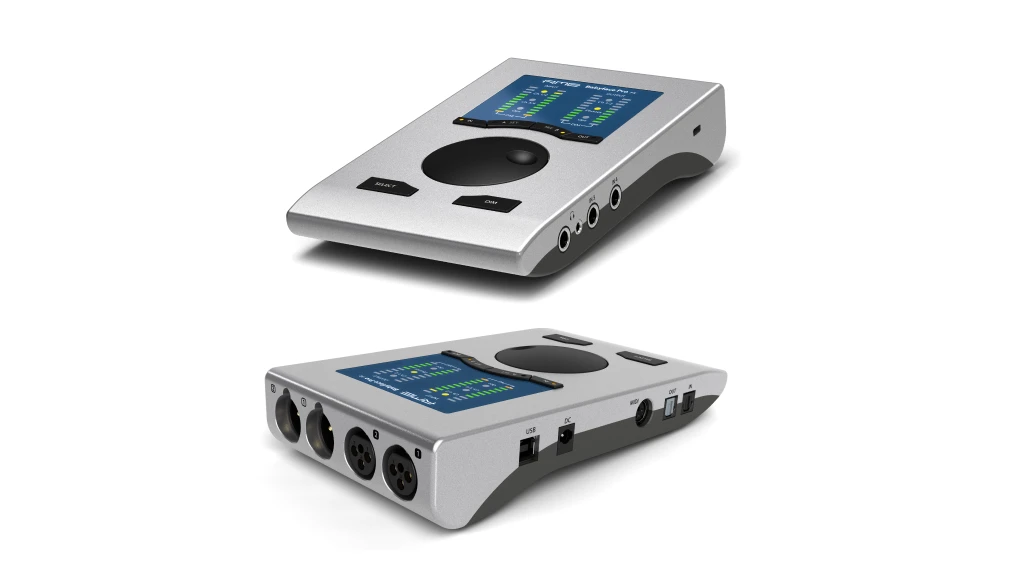
The construction of the Babyface Pro FS is top-notch. It’s built from a solid block of aluminum, giving it a reassuringly dense, sturdy feel that suggests it can handle life on the road. The main encoder wheel is large and responsive, and the meter display is bright and easy to read.
One design choice I particularly like is the placement of the analog inputs on the sides. While this might look a bit unusual, it keeps the top surface completely clean and focused on control. Furthermore, the inclusion of both 1/4-inch and 1/8-inch headphone jacks on the side is convenient because you don’t need an adapter to plug in your earbuds or consumer headphones.
However, the one area that requires attention is TotalMix FX. It is a powerful piece of software, but its deep functionality means it has a steeper learning curve than the simplified control panels found on cheaper interfaces. I recommend spending some time with the manual and tutorial videos early on. Once you master it, though, the routing possibilities are nearly limitless.
6. ADAT and TotalMix FX’s Power
One of the best long-term features of the RME Babyface Pro FS is its ADAT connection. This optical port allows you to add another 8 channels of mic preamps to your setup.
What It Means to Maximize Your Studio: When you start with a two-preamp interface like the Babyface, you’re primarily focused on recording one or two things at a time.
Nevertheless, as your needs grow—maybe you want to record a full drum kit or a band live—you need more inputs. Instead of buying a completely new, expensive interface, you can simply purchase an 8-channel preamp unit (like a Focusrite Clarett+ OctoPre) and connect it to the Babyface Pro FS via a single optical cable.
The Babyface Pro FS then acts as the central hub, providing the powerful TotalMix FX software and its stable drivers for all 10 of your analog inputs. Therefore, it’s the perfect scalable solution that gives you room to grow without needing to replace your core audio foundation. This flexibility is a huge part of the RME value proposition.
7. Final Thoughts on the RME Babyface Pro FS
The RME Babyface Pro FS is not a trendy audio interface; it is a serious, professional tool. It’s for the producer who has outgrown the common mid-range interfaces and needs a fundamental upgrade in stability, performance, and features. You are investing in RME’s world-class driver development and the proprietary SteadyClock FS technology, which simply translates to fewer headaches and more time creating.
It is absolutely the best choice if:
- You use virtual instruments heavily and need the lowest possible latency.
- You produce on both Mac and Windows and require identical, stable performance.
- You plan to expand your studio with ADAT preamps in the future.
Consequently, if you want to bypass the frustration of audio glitches and focus purely on your creative process, the Babyface Pro FS delivers on that promise better than almost anything else in its class. It is the ultimate insurance policy for your audio workflow.
8. FAQ
Does the RME Babyface Pro FS require an external power supply?
No, the RME Babyface Pro FS is primarily bus-powered, meaning it runs directly off the USB cable connected to your computer. This makes it incredibly convenient for mobile recording or when you are simply working in a coffee shop. However, an external power supply is only required if you plan to use the full 8-channel ADAT optical expansion or use the interface in its standalone, Class Compliant mode with an iPad.
How difficult is the TotalMix FX software for the Babyface Pro FS to learn?
TotalMix FX is more complex than the simple control panels on interfaces like the Focusrite Scarlett, but it is not “difficult” in the traditional sense. It’s just deep. It is essentially a full-featured mixing console within your computer, offering every routing option imaginable. I suggest starting with the basic monitoring setup and gradually exploring the advanced features like Loopback (for streaming/podcasting) and the DSP effects. In short, the learning curve is worth the unparalleled control you gain.
Is the RME Babyface Pro FS worth the money over cheaper interfaces?
For the casual hobbyist, probably not. But, for anyone who relies on their studio for their livelihood or who produces complex music, the answer is a resounding yes. You are paying for driver stability that prevents crashes during crucial tracking sessions, extremely high-quality conversion, and unique professional features like DC-coupled outputs. Therefore, the reliability and low-latency performance are priceless for a smooth workflow.
| Why Can You Trust Us

| ALSO REVIEWED