Best Apollo Audio Interface: How to Choose Right (2026)
- Audio Interface, Buying Guides
- by Bruno Bontempo
Looking for the best Apollo audio interface? I compare all 6 models from Solo to x16, helping you find the right UA interface for your studio setup.
Our articles may include affiliate links and we may earn a commission. Here how it works.
Jump to...
| QUICK OVERVIEW
Introduction
If you are looking for the best Apollo audio interface, the choice can feel overwhelming. Universal Audio offers eight distinct models, each targeting different studio needs and budgets. I have worked with multiple Apollo interfaces over the years, and the differences between them matter more than the spec sheets suggest.
The Apollo line stands apart from other interfaces because of three things: Unison preamp technology, onboard DSP processing, and the ability to record through plugin emulations with near-zero latency. These features let you commit to sounds while tracking, similar to working with actual hardware. Therefore, picking the right model comes down to how many inputs you need, how much DSP power you want, and where you plan to use it.
In 2024, Universal Audio released the Gen 2 versions of the rackmount Apollo X series, bringing improved converters, Auto-Gain functionality, and Apollo Monitor Correction powered by Sonarworks. As a result, the entire lineup now shares a consistent feature set that scales with your needs.
Best Budget
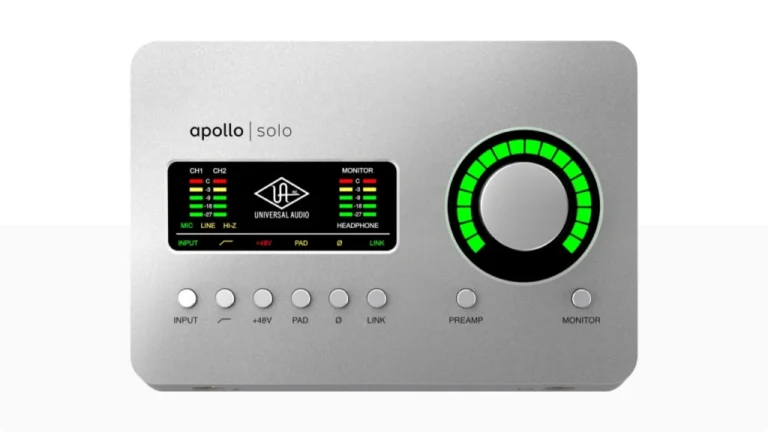
Apollo Solo
4.5
The Apollo Solo delivers authentic UA sound in a bus-powered format that fits in your laptop bag. With two Unison preamps and SOLO Core processing, it handles vocal and guitar tracking sessions while giving you access to the entire UAD plugin library. This is the entry point into the Apollo ecosystem without compromise.
| Key Features
- Inputs: 2 mic/line combo inputs, 1 Hi-Z instrument input (front panel)
- Outputs: 2 monitor outputs, 1 headphone output
- Compatibility: macOS and Windows (Thunderbolt version), Windows only (USB version)
- Connectivity: Thunderbolt 3 (bus-powered) or USB 3.0 (external power required)
- Resolution: 24-bit / 192 kHz
- Plus: Includes Realtime Analog Classics plugin bundle with UA 610-B, LA-2A, 1176, Marshall, and Ampeg emulations. Heritage Edition adds 11 additional plugins.
| Best for...
- You need a portable interface for mobile recording sessions
- You want to start with UAD plugins without a large investment
- You primarily record one or two sources at a time
- You need a secondary interface for working outside your main studio
- You want the best-sounding bus-powered interface available
| Not ideal for...
- You plan to record drums or full bands simultaneously
- You need talkback functionality for studio sessions
- You want to daisy-chain with other Apollo interfaces
Overview
The Apollo Solo replaced the Arrow in 2020, and it remains the most affordable way to access genuine Apollo conversion and Unison preamp technology. The interface feels solid despite its compact size, with an all-metal construction that survives life in a backpack.
What makes the Solo special is the Unison technology. When you load a Unison plugin like the Neve 1073 or API Vision, the preamp circuit actually adjusts its impedance and gain staging to match the original hardware. In other words, your microphone interacts with the Solo the same way it would with the modeled preamp.
The SOLO Core DSP handles one or two Unison plugins during tracking without issue. However, you will hit limitations when mixing with UAD plugins. For instance, running several compressors and EQs on multiple tracks exhausts the processing quickly. Many users treat the Solo as a tracking interface and then mix with a Satellite or larger Apollo system.
The Thunderbolt version works on Mac and Windows and draws power directly from the connection. The USB version requires an external power supply but opens the door for Windows users without Thunderbolt ports. Both sound identical.
One limitation: the Solo cannot function as a master controller in a multi-Apollo setup. If you plan to expand your system, consider the Twin X instead.
READ FULL REVIEW
Best Value
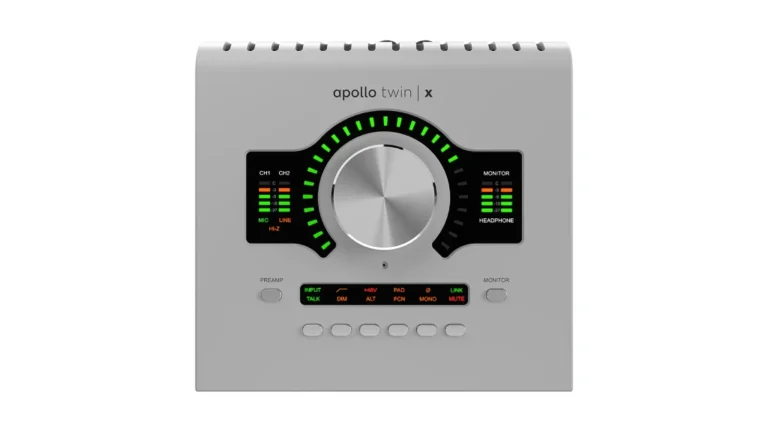
Apollo Twin X
4.6
The Apollo Twin X offers the sweet spot between capability and footprint. With dual Unison preamps, up to QUAD Core DSP, and full monitor control features, it works as both a standalone interface and the control center for larger Apollo systems. The Gen 2 version adds Auto-Gain, improved converters, and Sonarworks integration.
| Key Features
- Inputs: 2 mic/line combo inputs, 1 Hi-Z instrument input, optical ADAT/S/PDIF (up to 8 additional channels)
- Outputs: 2 monitor outputs, 2 line outputs (ALT), 1 headphone output
- Compatibility: macOS and Windows
- Connectivity: Thunderbolt 3 (external power required)
- Resolution: 24-bit / 192 kHz, 129 dB dynamic range
- Plus: Built-in talkback mic, monitor controller with dim/mute/mono functions, expandable to 128 channels with additional Apollos. Available in DUO or QUAD Core versions with Essentials+ or Studio+ plugin bundles.
| Best for...
- You need a desktop interface that doubles as a monitor controller
- You want room to grow by adding rackmount Apollos later
- You record vocals, guitar, and synths as your primary workflow
- You need talkback for communicating with artists
- You want more DSP than the Solo provides
| Not ideal for...
- You need more than two simultaneous mic inputs
- You need talkback functionality for You require 5.1 or higher surround monitoringstudio sessions
- You exclusively use Windows without Thunderbolt
Overview
The Apollo Twin X has been the best-selling professional desktop interface for years, and the Gen 2 update refines an already mature product. The desktop wedge design puts controls exactly where you need them, with a large encoder for gain and monitor levels plus dedicated buttons for phantom power, input selection, and monitoring functions.
The difference between DUO and QUAD comes down to DSP power. The DUO handles tracking through Unison plugins comfortably, while the QUAD provides headroom for more complex Console setups and DAW-based UAD plugin use. If your budget allows, the QUAD version prevents frustration as your projects grow.
The Gen 2 converters measure 129 dB dynamic range with -117 dB THD+N. In practice, this translates to recordings that feel open and dimensional without harshness. The headphone amplifier punches well above its class, delivering high output with low noise.
Auto-Gain simplifies tracking sessions significantly. Select your inputs, have the artist perform at their loudest, and the system sets appropriate gain levels automatically. This feature works with most Unison preamp plugins, matching gain staging to the specific emulation.
The optical input expands the Twin X from 2 to 10 inputs when connected to an ADAT preamp. Similarly, you can daisy-chain up to four Thunderbolt Apollos for 128 total channels, with the Twin X serving as your desktop controller. This scalability makes it future-proof.
The Monitor Correction feature, available as an add-on with Sonarworks, runs directly on the Apollo DSP. Therefore, you can calibrate your monitors without adding latency or using computer resources.
READ FULL REVIEW
Best for Home Studios
Apollo x4
4.7
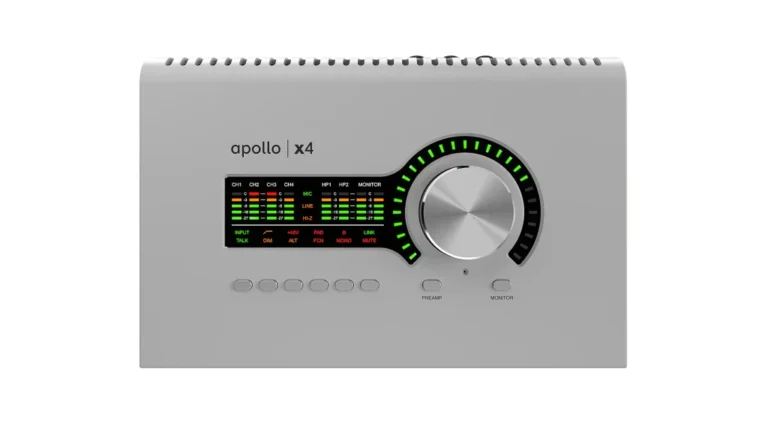
The Apollo x4 doubles the preamp count and adds a second headphone output, making it ideal for collaborative sessions. With four Unison preamps, QUAD Core DSP, and a desktop form factor, it bridges the gap between the Twin X and rackmount units.
| Key Features
- Inputs: 4 mic/line combo inputs, 2 Hi-Z instrument inputs (front panel), optical ADAT/S/PDIF (up to 8 additional channels)
- Outputs: 2 monitor outputs, 4 line outputs (ALT), 2 independent headphone outputs
- Compatibility: macOS and Windows
- Connectivity: Thunderbolt 3 (external power required)
- Resolution: 24-bit / 192 kHz, 129 dB dynamic range
- Plus: Built-in talkback mic, dual headphone mixes for collaborative work, bass management for subwoofer integration. Available with Essentials+ or Studio+ plugin bundles.
| Best for...
- You record singer-songwriters or small ensembles
- You need separate headphone mixes for artist and producer
- You want four quality preamps without a rackmount unit
- You work with external synths and drum machines
- You need a desktop interface with expansion potential
| Not ideal for...
- You need surround monitoring beyond stereo with subwoofer
- You primarily record single sources
- Rack space is not a concern for your setup
Overview
The Apollo x4 fills a specific need: producers who regularly record more than two sources but do not want a rackmount interface. The desktop format keeps controls accessible while the four preamps handle most home studio scenarios.
Having two front-panel Hi-Z inputs changes the workflow for guitarists and bassists. You can plug in directly without reaching around back, which sounds minor until you are in a session. Both instrument inputs accept Unison amp modeling for authentic amp tones during tracking.
The dual headphone outputs with independent level controls solve a common problem in project studios. The artist can have their own mix while you monitor something different. This feature alone justifies the x4 over the Twin X for anyone who collaborates regularly.
Like the Twin X, the x4 Gen 2 includes Auto-Gain, Monitor Correction support, and bass management. The QUAD Core DSP matches the Twin X QUAD, so processing power is identical. The main difference is I/O count and form factor.
The six line outputs enable stereo monitoring plus two ALT speaker pairs, or you can configure them for a subwoofer setup using the built-in bass management crossover. For home studios without dedicated outboard gear, the x4 provides everything needed in a single unit.
LABEL
Article
Best for Outboard Gear
Apollo x6
4.8
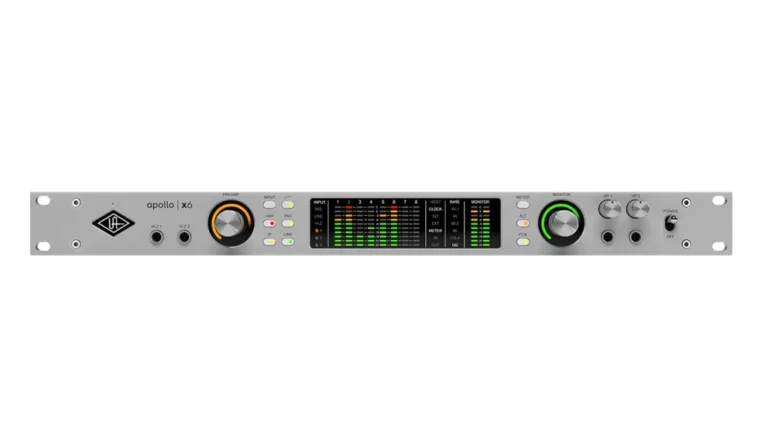
The Apollo x6 targets producers who work with external synthesizers, hardware processors, and line-level sources. With two Unison preamps plus six additional line inputs, HEXA Core DSP, and 5.1 surround support, it delivers professional capability without the extra mic preamps found in larger units.
| Key Features
- Inputs: 2 mic/line combo inputs, 6 line inputs, 2 Hi-Z instrument inputs, dual ADAT S/MUX, S/PDIF coaxial, wordclock
- Outputs: 2 monitor outputs, 6 line outputs (ALT / 5.1 surround), 2 headphone outputs
- Compatibility: macOS and Windows
- Connectivity: Thunderbolt 3 (external power required), rackmount 1U
- Resolution: 24-bit / 192 kHz, 130 dB dynamic range
- Plus: HEXA Core DSP (6 SHARC processors), surround monitoring up to 5.1, word clock I/O for sync with external gear. Available with Essentials+ or Studio+ plugin bundles.
| Best for...
- You work primarily with synthesizers and electronic instruments
- You have dedicated outboard preamps you prefer
- You need 5.1 surround monitoring capability
- You want maximum DSP power without extra mic preamps
- You integrate with high-end external gear requiring word clock
| Not ideal for...
- You record bands requiring multiple simultaneous mic inputs
- You do not use external hardware sources
- Desktop form factor better suits your space
Overview
The Apollo x6 represents smart engineering for a specific workflow. Instead of filling the unit with mic preamps that some producers never use, UA provided two quality Unisons plus six line inputs for hardware synths, drum machines, and external processing.
The HEXA Core processing makes a noticeable difference. With six SHARC DSP chips, the x6 handles complex Console setups and extensive DAW-based UAD plugin use without running out of steam. If you mix with multiple UAD compressors and EQs across your session, this headroom matters.
The two headphone outputs with independent controls work well for collaborations, and the six line outputs provide flexibility for surround monitoring up to 5.1 or multiple speaker switching configurations. Word clock I/O ensures tight sync when connecting to other high-end digital gear.
For producers working in hybrid setups, the x6 connects naturally to outboard compressors and EQs via its line I/O while maintaining the ability to track vocals and guitars through the Unison preamps. It bridges the hardware and software worlds effectively.
The rackmount format fits standard studio furniture, though the front-panel Hi-Z inputs remain accessible for quick instrument tracking.
LABEL
Article
Best for Tracking Bands
Apollo x8 (p)
4.9
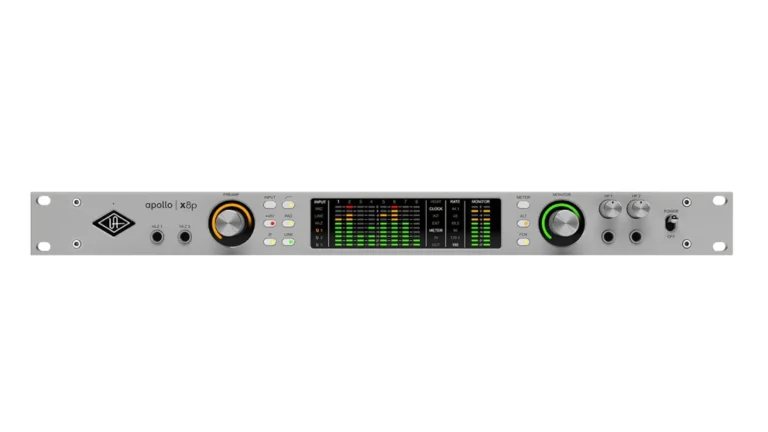
The Apollo x8 and x8p target professional tracking rooms that need multiple high-quality preamps. The x8 offers four Unison preamps with line I/O expansion, while the x8p provides eight Unison preamps for large ensemble recording. Both include HEXA Core DSP and 7.1 surround support.
| Key Features
- Inputs: 8 mic/line combo inputs (all Unison-enabled), 2 Hi-Z instrument inputs, 8 line inputs via DB-25, dual ADAT S/MUX, wordclock
- Outputs: 2 monitor outputs, 8 line outputs via DB-25 (ALT / 7.1 surround), 2 headphone outputs
- Compatibility: macOS and Windows
- Connectivity: Thunderbolt 3 (external power required), rackmount 1U
- Resolution: 24-bit / 192 kHz, 130 dB dynamic range, -127 dB THD+N
- Plus: HEXA Core DSP, 7.1 surround monitoring, DB-25 connectivity for professional patchbays. Available with Essentials+ or Studio+ plugin bundles.
| Best for...
- You record full bands, drums, or large ensembles
- You need eight simultaneous mic inputs with identical quality
- You work in film or post requiring 7.1 surround
- You have existing DB-25 infrastructure in your studio
- You want to track an entire session through Unison preamps
| Not ideal for...
- You rarely need more than four simultaneous inputs
- Your workflow is primarily mixing rather than tracking
- You work exclusively in stereo
Overview
The Apollo x8p exists for one reason: tracking sessions where you need eight quality mic preamps working simultaneously. Recording drums with room mics, capturing a full band live, or running multiple vocalists during group sessions all demand this capability.
Every input on the x8p is Unison-enabled, meaning you can track eight channels through Neve, API, or SSL preamp emulations at once. The Auto-Gain feature becomes especially valuable here, setting optimal levels across all channels with a single training pass. This speeds up session setup significantly.
The DB-25 connectivity integrates cleanly with professional patchbays and outboard gear. Eight additional line inputs and outputs provide expansion for processing or additional sources. Similarly, dual ADAT ports add up to 16 more channels when connected to external preamps.
The Gen 2 improvements brought THD+N down to -127 dB and dynamic range up to 130 dB. These specifications rival dedicated high-end converters, meaning the x8p does not compromise audio quality for the sake of feature count.
Surround monitoring up to 7.1 handles most film and post-production requirements. The bass management and speaker switching features work identically to other Apollo X Gen 2 models.
The standard x8 offers four Unison preamps plus line expansion for studios that need the I/O but have external preamps they prefer. Otherwise, the x8p provides the complete solution.
LABEL
Article
Best for Professional Studios
Apollo x16
4.9
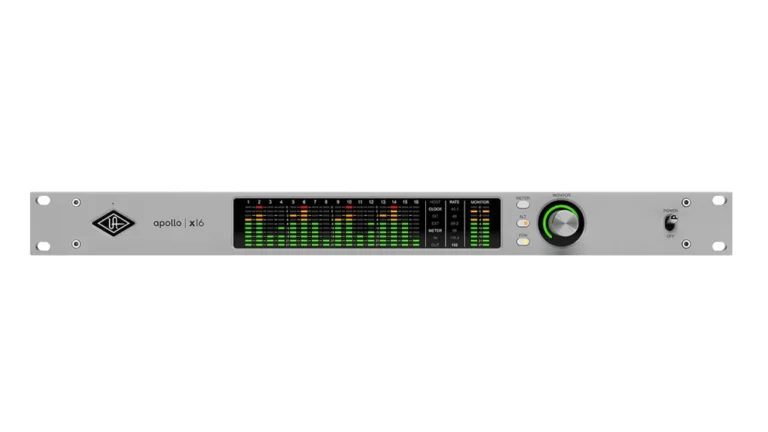
The Apollo x16 serves as the flagship interface for professional studios requiring pristine conversion, maximum I/O, and Dolby Atmos-capable immersive audio monitoring. The x16D variant adds Dante networking for live sound and multi-room studio applications.
| Key Features
- Inputs: 16 line inputs via DB-25, dual AES/EBU, dual ADAT S/MUX, wordclock
- Outputs: 16 line outputs via DB-25, 2 monitor outputs, 2 headphone outputs
- Compatibility: macOS and Windows
- Connectivity: Thunderbolt 3 (external power required), rackmount 1U
- Resolution: 24-bit / 192 kHz, 133 dB dynamic range (D/A), -129 dB THD+N
- Plus: HEXA Core DSP, immersive audio monitoring up to 9.1.6 for Dolby Atmos, Auro-3D, and Sony 360 Reality Audio. Switchable +24 dBu operation for console integration. Available with Essentials+ or Ultimate+ plugin bundles. x16D adds 16x16 Dante I/O.
| Best for...
- You need to integrate with an analog console or summing mixer
- You create immersive audio for Dolby Atmos or spatial formats
- You require the highest conversion quality available
- You want 16 channels of identical A/D and D/A conversion
- You operate a multi-room studio requiring networked audio (x16D)
| Not ideal for...
- You rarely need moreYou need built-in mic preampsthan four simultaneous inputs
- Your projects do not require high channel counts
- You work exclusively in stereo without surround requirements
Overview
The Apollo x16 approaches audio conversion differently than other models. Instead of including mic preamps, it focuses entirely on providing 16 channels of reference-quality A/D and D/A conversion. Studios pairing it with high-end outboard preamps get the best of both worlds.
The conversion specifications set records for the Apollo line: 133 dB dynamic range on the D/A side with -129 dB THD+N. These measurements compete with dedicated mastering converters. For critical listening and mixing decisions, this quality translates to confidence that what you hear represents the actual audio.
Immersive audio support up to 9.1.6 makes the x16 capable of Dolby Atmos mixing without additional hardware. The UAD Console app provides speaker mapping, calibration, and metering specifically designed for immersive formats. Bass management ensures accurate subwoofer integration across all configurations.
The switchable +24 dBu headroom accommodates professional consoles and outboard gear operating at higher levels. DB-25 connectivity connects directly to patchbays, making integration with existing studio infrastructure straightforward.
The Apollo x16D adds 16×16 Dante I/O alongside the Thunderbolt connection. This enables UAD plugin processing over networked audio for live sound applications or multi-room studio setups. Up to four x16Ds can be linked for 64 channels of Dante processing with network redundancy.
For studios already invested in quality preamps, the x16 provides the conversion backbone without redundant features.
Comparison Table
Find the Apollo audio interface that matches your workflow. This side-by-side comparison shows the essential specs you need to make your decision. Check the inputs, outputs, DSP power, and special features to identify which model fits your studio.
| Model | Category | Inputs | Outputs | Resolution | Compatibility | Connectivity | Plus |
|---|---|---|---|---|---|---|---|
| Apollo Solo | Best Budget Pick | 2 mic/line, 1 Hi-Z | 2 monitor, 1 headphone | 24-bit / 192 kHz | macOS, Windows | Thunderbolt 3 (bus-powered) or USB 3.0 | SOLO Core DSP, Unison preamps, portable design |
| Apollo Twin X | Top Pick | 2 mic/line, 1 Hi-Z, 8 ADAT | 2 monitor, 2 line (ALT), 1 headphone | 24-bit / 192 kHz, 129 dB dynamic range | macOS, Windows | Thunderbolt 3 | DUO or QUAD Core DSP, talkback mic, Auto-Gain, Monitor Correction |
| Apollo x4 | Best for Home Studios | 4 mic/line, 2 Hi-Z, 8 ADAT | 2 monitor, 4 line (ALT), 2 headphones | 24-bit / 192 kHz, 129 dB dynamic range | macOS, Windows | Thunderbolt 3 | QUAD Core DSP, dual headphone mixes, bass management, talkback |
| Apollo x6 | Best for Producers with Outboard | 2 mic/line, 6 line, 2 Hi-Z, ADAT, S/PDIF | 2 monitor, 6 line (5.1), 2 headphones | 24-bit / 192 kHz, 130 dB dynamic range | macOS, Windows | Thunderbolt 3, 1U rack | HEXA Core DSP, 5.1 surround, word clock I/O |
| Apollo x8 | Best for Project Studios | 4 mic/line, 4 line, 2 Hi-Z, ADAT, S/PDIF | 2 monitor, 8 line (7.1), 2 headphones | 24-bit / 192 kHz, 130 dB dynamic range | macOS, Windows | Thunderbolt 3, 1U rack | HEXA Core DSP, 7.1 surround, DB-25 connectivity |
| Apollo x8p | Best for Tracking Bands | 8 mic/line, 8 line (DB-25), 2 Hi-Z, ADAT | 2 monitor, 8 line (7.1), 2 headphones | 24-bit / 192 kHz, 130 dB dynamic range | macOS, Windows | Thunderbolt 3, 1U rack | HEXA Core DSP, 8 Unison preamps, 7.1 surround |
| Apollo x16 | Best for Pro Studios | 16 line (DB-25), AES, ADAT | 16 line (DB-25), 2 monitor, 2 headphones | 24-bit / 192 kHz, 133 dB dynamic range | macOS, Windows | Thunderbolt 3, 1U rack | HEXA Core DSP, Dolby Atmos 9.1.6, +24 dBu operation |
| Apollo x16D | Best for Live Sound / Networks | 16 Dante, AES, ADAT | 16 Dante, 2 monitor, 2 headphones | 24-bit / 192 kHz, 133 dB dynamic range | macOS, Windows, Dante networks | Thunderbolt 3, Dante, 1U rack | HEXA Core DSP, 64-ch Dante (4 units), Dolby Atmos 9.1.6 |
Choosing the Best Apollo Audio Interface for Your Setup
The Apollo line scales from portable to professional, but the right choice depends on your specific workflow. Consider your primary use case: are you tracking, mixing, or both? How many simultaneous inputs do you actually need? Do you work in stereo, surround, or immersive formats?
For most home studio producers, the Apollo Twin X or Apollo x4 provides the ideal balance. Both offer genuine UA quality with room to expand. If portability matters or budget is tight, the Apollo Solo gets you into the ecosystem without compromise.
Studios tracking full bands should look at the x8p for its eight Unison preamps, while producers working with external synthesizers and outboard gear may find the x6 more appropriate. Professional facilities requiring maximum conversion quality and immersive audio support will want the x16.
The Dante products, including the x16D, e1x, and e2m, serve networked audio environments specifically. Live sound engineers and multi-room studio operators benefit most from this capability.
All current Apollo interfaces share the Gen 2 feature set: Auto-Gain, Monitor Correction support, Bass Management, and Plug-In Scenes. These workflow improvements matter regardless of which model you choose. The differences come down to I/O count, DSP power, and form factor.
The UAD plugin ecosystem remains consistent across all models. Whether you buy a Solo or an x16, you access the same library of over 200 plugins. Your investment in plugins follows you if you upgrade interfaces later.
CHECK ALSO
FAQ
Does a Thunderbolt cable come included with Apollo interfaces?
No. Apollo Thunderbolt interfaces do not include a Thunderbolt cable in the box. You need to purchase one separately. Universal Audio recommends using cables from reputable brands like Apple, Belkin, or OWC, and keeping the length at 2 meters or shorter for best performance. For Thunderbolt 3 models like the Twin X or x4, make sure you get a Thunderbolt 3 or 4 cable, not just a USB-C cable. Although both use the same connector shape, USB-C cables will not work with Thunderbolt interfaces. Look for the lightning bolt symbol on the cable to confirm it is Thunderbolt certified.
Can I use UAD plugins without Apollo hardware?
Yes. Universal Audio now offers native versions of most UAD plugins that run on your computer’s CPU without requiring Apollo hardware or UAD-2 DSP cards. You can purchase individual native plugins or subscribe to UAD Spark for access to a growing library. The native versions sound identical to the DSP versions since they use the same code. However, running plugins natively means they use your computer’s processing power instead of dedicated DSP chips. The main advantage of Apollo hardware remains the ability to track through plugins with near-zero latency using the Console application, something native plugins cannot replicate without adding latency to your monitoring signal.
Can I combine multiple Apollo interfaces together?
Yes, with some limitations. You can connect up to four Thunderbolt Apollo interfaces together for expanded I/O and combined DSP power, resulting in up to 128 channels. However, only one desktop model (Solo, Twin X, or x4) can be included in the chain. Therefore, if you want to expand beyond a Twin X, you would add rackmount units like the x8 or x16 rather than another Twin. Additionally, USB Apollo models cannot be combined with Thunderbolt models. The Apollo Solo specifically cannot be daisy-chained at all and functions only as a standalone interface. When combining units, one desktop Apollo can serve as the monitor controller for the entire system.
| Why Can You Trust Us
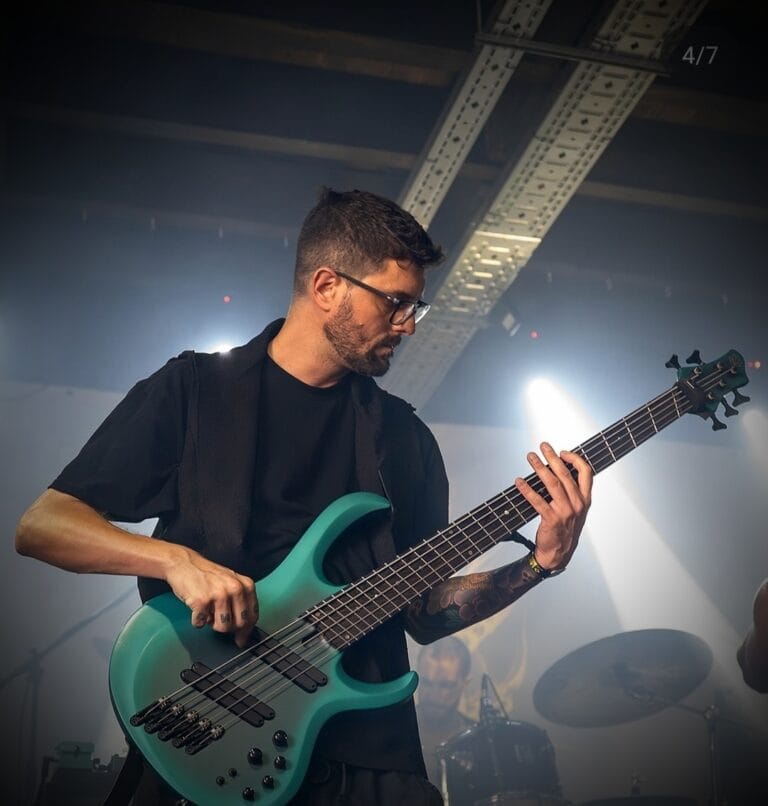
Bruno Bontempo
I've been recording, producing, and playing bass for over 20 years—from touring with my first band at 15 to playing progressive metal across Europe today. Through multiple albums, projects (Madness of Light, Rising Course, Roots of Ascendant, Human|Archive), and production work, I've tested audio interfaces in every scenario imaginable. At Best Audio Hub, I combine my historian background with years of hands-on music and audio experience. No marketing fluff—just honest insights from someone who's been in the trenches.
| ALSO REVIEWED