Apollo Solo Review (2026): Is UAD Processing Worth the Price?
- Audio Interface, Reviews
- by Bruno Bontempo
Our articles may include affiliate links and we may earn a commission. Here how it works.
OUR VERDICT
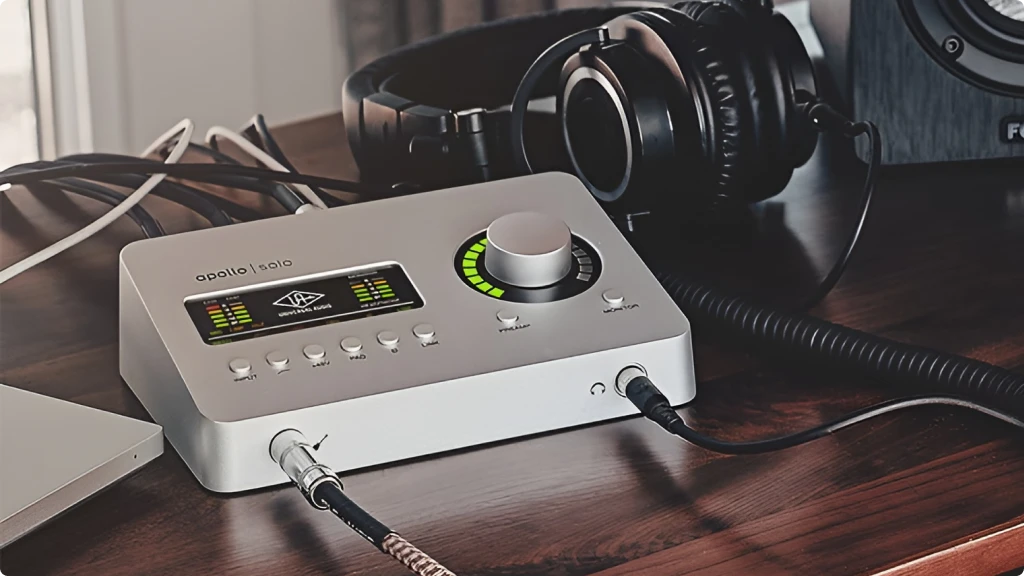
The Universal Audio Apollo Solo is a premium portable audio interface that delivers on its promise: studio-quality sound in a package you can throw in your backpack. The combination of Unison preamp technology and real-time UAD-2 processing gives you access to legendary analog sounds without taxing your computer’s CPU.
The Apollo Solo isn’t just an audio interface. If you already use UAD plugins or plan to build your collection, this interface becomes the centerpiece of a powerful mobile studio.
Release Date
Aug 2020
16x 2x6 cm
6.3x4.7x2.4 in
1 kg
2.2 lb
| Pros
- Studio-grade preamps with transparent, low-noise performance
- Unison technology delivers authentic analog preamp emulations
- Real-time UAD processing tracks with zero latency, zero CPU usage
- Premium 24-bit/192kHz conversion captures every detail
- Console software provides professional routing and mixing
| Cons
- Only Input 1 has Unison capability (Input 2 is standard)
- Software-based control rather than hardware knobs
- Limited to 2 inputs
| Key Features
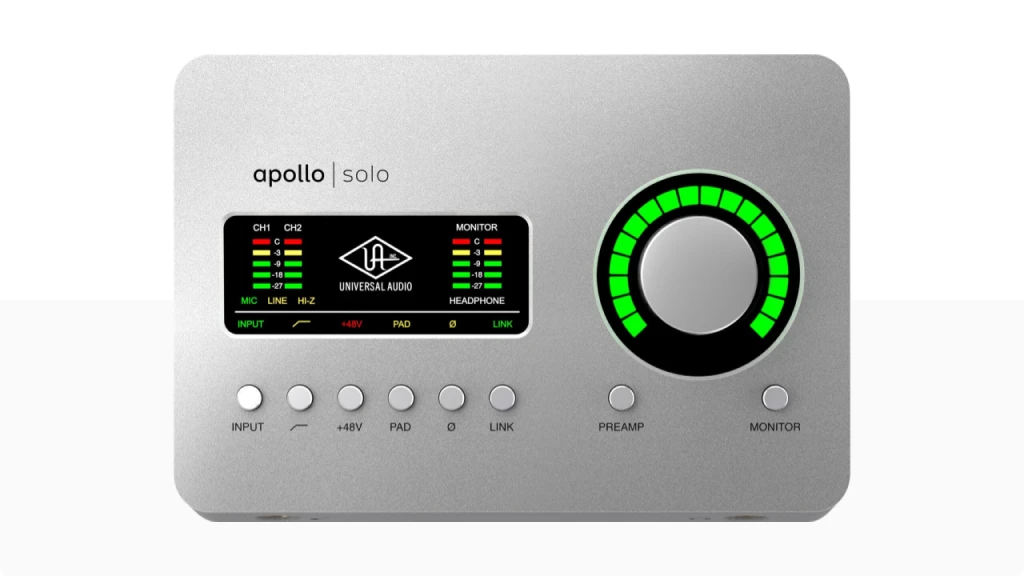
- Inputs: 2x Unison-enabled XLR/TRS combo
- Outputs: 2x TRS + 1x headphone
- Compatibility: MacOS, Windows
- Connectivity: USB 3.0 and Thunderbolt 3 versions available
- Resolution: 24-bit/192kHz
-
Plus:
UAD real-time processing, Unison-enabled preamp
| Best for...
- Mobile producers who need studio-quality sound on location
- Singer-songwriters recording vocals and acoustic instruments
- Content creators (podcasters/streamers) who want plugin processing without computer strain
- Musicians who already own UAD plugins
- Producers who need professional monitoring accuracy
| Not ideal for...
- Multi-input recording (only 2 inputs, both on front panel)
- Budget-conscious beginners (premium price)
- -
1. Apollo Solo Overview
When Universal Audio released the original Apollo Twin, they changed the game for home studio interfaces. The Apollo Solo takes that same philosophy and shrinks it down to a truly portable form factor without sacrificing the core technologies that make Apollo interfaces special.
The Apollo Solo sits in UA’s lineup as the entry point to their ecosystem. It’s smaller than the Twin, with fewer inputs and less DSP processing power, but it maintains the same exceptional audio quality. For many creators, especially those working primarily with vocals and single instruments, the Solo’s two-input configuration is more than sufficient.
2. Key Apollo Solo Features Explained
The Apollo Solo packs several technologies into its compact aluminum chassis that work together to deliver a professional recording experience. Let’s break down what each feature actually does and why it matters for your workflow.
Unison Preamp Technology
Unison is Universal Audio’s proprietary technology that allows their preamp emulation plugins to control the actual physical characteristics of the Apollo’s mic preamps. This goes beyond digital processing—the plugin actually changes the input impedance and gain staging behavior of the hardware itself.
- What It Means for You: When you load a Neve, API, or Manley preamp plugin, the Apollo Solo’s preamp responds like that actual hardware. The input impedance changes, the gain staging adjusts, and the sonic character matches the original gear. This is the closest you can get to tracking through vintage preamps without owning them.
UAD-2 SOLO Core Processing
The Apollo Solo includes a single SHARC processor dedicated to running UAD plugins in real-time. This is the same DSP architecture used in Universal Audio’s premium interfaces, just with less total processing power.
- What It Means for You: You can track vocals through compression, EQ, and even reverb without hearing any latency and without using your computer’s CPU at all. The DSP handles all the processing. For podcast editing or voiceover work, you can build your entire processing chain during tracking and it just works.
Elite-Class AD/DA Conversion
Universal Audio uses premium converters spec’d at 24-bit/192kHz. The measured specifications show a dynamic range of 120dB on the outputs and 114dB on the inputs—these are genuinely professional numbers.
- What It Means for You: Your recordings capture subtle details that cheaper interfaces miss. The noise floor is incredibly low, so even quiet acoustic instruments come through clearly. The difference is most noticeable on delicate sources like classical guitar, voice, or room ambience.
Console Application
The Apollo Solo is controlled through UA’s Console software, which runs on your computer. Console provides routing, monitor mixing, and plugin loading all in one interface.
- What It Means for You: Unlike simple interfaces with hardware knobs, Console gives you deep control over every aspect of your signal flow. You can set up complex monitor mixes, create custom headphone feeds with different effects, and save snapshots of entire sessions. However, this means you’re managing things in software rather than reaching for a physical knob.
3. Apollo Solo Specs
| Feature | Specification | Practical Benefit |
|---|---|---|
| Simultaneous I/O | 2x2 Analog | Record vocals while hearing yourself through monitors |
| XLR Mic Input | 2 (1 with Unison) | Plug in any professional microphone; Input 1 gets the vintage preamp |
| Hi-Z Input | 2 (Hi-Z on front) | Plug your guitar straight in |
| Line/Monitor Output | 2x 1/4" TRS balanced | Connect studio monitors without ground loop hum or noise |
| Headphone Output | 1x 1/4" TRS | Drives your headphones loud and clear for detailed listening |
| Compatibility | macOS, Windows | Works with Logic, Ableton, Pro Tools, Reaper—any DAW |
| Preamps | Up to 65dB | Enough power for quiet ribbon mics without adding hiss |
| Resolution | 24-bit/192kHz | Captures the breath before a vocal phrase and room reverb tails clearly |
| Phantom Power | +48V switchable | Turn on for condenser mics, off for dynamics—protects your gear |
| Direct Monitor | Via Console software | Hear yourself singing with reverb instantly—no delay, no distraction |
| Connectivity | USB 3.0 or Thunderbolt 3 | USB works with any laptop; Thunderbolt is slightly faster on Macs |
| Plus | Realtime UAD-2 Processing | Track vocals through a $3,000 compressor emulation without owning the hardware |
4. Performance: Studio Sound Anywhere
The Apollo Solo’s performance is where Universal Audio’s reputation truly shows. The combination of clean preamps, premium conversion, and UAD processing creates a recording chain that rivals setups costing significantly more.
The mic preamps on the Apollo Solo are exceptionally transparent. They don’t add color or character on their own—that’s what the Unison plugins are for. During testing, the preamps delivered a noise floor low enough that even whisper-quiet passages on acoustic guitar came through without hiss. The 65dB of available gain meant even my low-output ribbon mic had plenty of headroom.
The real magic happens when you start using UAD plugins through Console. The ability to track vocals through an 1176 compressor and Pultec EQ without hearing any latency is remarkable.
The performance feels identical to tracking through hardware—there’s no compromise in the feel or response.
During my testing, I could comfortably run the Neve 1073 preamp emulation, an 1176 compressor, and a basic EQ simultaneously on the SOLO Core processor. Adding a UAD reverb maxed out the available DSP, but for tracking purposes, that’s more than sufficient.
The key is understanding that the SOLO Core is designed for tracking, not mixing—you’ll use native plugins for mixing later.
The AD/DA conversion is pristine. Listening back to test recordings revealed nuances in room tone and instrument overtones that often get lost on budget interfaces. The stereo imaging was particularly impressive—panning instruments across the stereo field maintained perfect separation and clarity.
5. Design and Usability
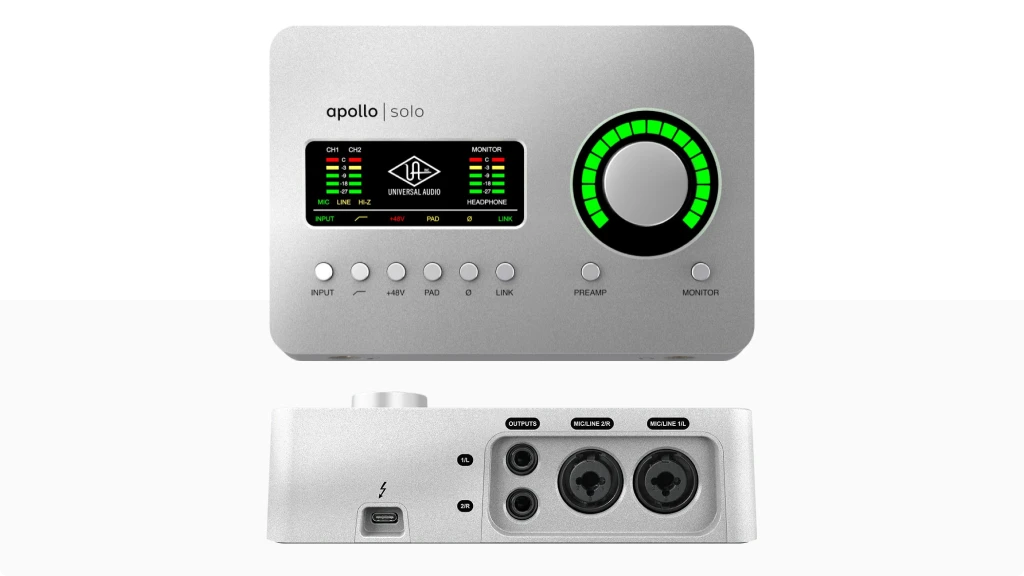
The Apollo Solo’s industrial design reflects Universal Audio’s commitment to build quality. The chassis is machined from a single block of aluminum, giving it a substantial, confidence-inspiring heft. It feels like professional gear, not a consumer gadget.
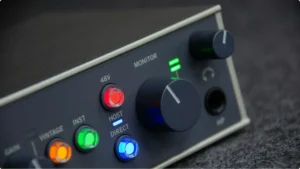
The front panel layout is logical: two combo inputs with individual gain controls, 48V phantom power switches, and a large volume knob for the headphone output. The minimalist design means fewer things to break and a clean aesthetic that fits any workspace.
Control Surface
Unlike the Apollo Twin, the Solo doesn’t have dedicated hardware controls for every function. Instead, you manage routing, plugin loading, and monitor mixing through the Console software.
This design choice reduces cost and size but means you’ll be clicking rather than turning knobs during sessions. For some users, this is fine—modern producers are used to software-based workflows.
For others who prefer hands-on control, the lack of hardware DSP knobs might feel limiting. It’s a trade-off for the compact form factor.
6. Console Software & UAD Plugin Ecosystem
Universal Audio’s Console application is the command center for the Apollo Solo. It handles all routing, monitoring, and plugin management. While it has a learning curve, Console’s capabilities far exceed the simple mixer apps that ship with budget interfaces.
Key Console Features:
- Unison Preamp Loading: Each input channel has a slot where you insert Unison preamp plugins, which then control the physical preamp behavior.
- Zero-Latency Monitoring: Console creates monitor mixes that route directly to your headphones with UAD processing, bypassing your DAW entirely for latency-free tracking.
- Snapshots: Save complete Console configurations and recall them instantly for different projects or recording scenarios.
- Monitor Mix Flexibility: Create custom headphone mixes with different levels and effects than what you’re hearing through monitors.
Console is powerful but not immediately intuitive if you’re coming from simpler interfaces. Plan to spend time with the manual and watch tutorial videos. Once you understand the signal flow, Console becomes second nature and offers workflow advantages that simple hardware controls can’t match.
The UAD Plugin Ecosystem: The Apollo Solo is your entry point into Universal Audio’s plugin ecosystem, and it’s important to understand how this works before purchasing.
The Apollo Solo includes the Analog Classics Plus plugin bundle, which gives you:
- UA 610-B Tube Preamp & EQ (Unison)
- Raw Distortion
- Softube Amp Room Essentials
- Galaxy Tape Echo
- Pure Plate Reverb
- Precision Channel Strip
- And a few others
These plugins give you a solid starting point for tracking and mixing, but they’re just a taste of UA’s full catalog.
- What It Means for You: Unlike simple interfaces with hardware knobs, Console gives you deep control over every aspect of your signal flow. You can set up complex monitor mixes, create custom headphone feeds with different effects, and save snapshots of entire sessions. However, this means you’re managing things in software rather than reaching for a physical knob.
Alternative Perspective: If you’re happy with native plugins (from companies like FabFilter, Soundtoys, or built into your DAW), the Apollo Solo still delivers exceptional audio quality. You’re just not using it to its fullest potential. In that case, consider whether a less expensive interface might serve you better.
7. Final Thoughts on the Apollo Solo
The Universal Audio Apollo Solo is not an audio interface for everyone, and that’s okay. It’s a specialized tool designed for a specific user: someone who values studio-quality sound in a portable package and wants access to legendary analog emulations without buying the actual hardware.
If you fall into that category, the Apollo Solo delivers exceptional value despite its premium price. The build quality, sound fidelity, and UAD processing create a recording experience that simply doesn’t exist at this price point anywhere else. The ability to track vocals through a Neve preamp and 1176 compressor with zero latency is transformative for mobile recording workflows.
However, be realistic about the DSP limitations of the SOLO Core processor and understand that Input 2 doesn’t support Unison. If these limitations feel too restrictive, consider stepping up to the Apollo Twin.
For the mobile producer, traveling engineer, or content creator who refuses to compromise on audio quality, the Apollo Solo is the best portable interface available. It’s the studio in your backpack.
8. FAQ
Can I use the Apollo Solo for live streaming?
Sure. The Apollo Solo’s low latency and real-time effects make it ideal for streamers who want professional sound quality on their broadcasts.
Check our full guide of the best audio interfaces for streaming.
Is the Apollo Solo compatible with Windows and Mac?
Yes, it’s compatible with both Mac and Windows systems, but check that your system meets the Thunderbolt or USB-C requirements.
How does the Apollo Solo differ from the Apollo Twin
The main difference is that the Apollo Twin offers additional inputs and more DSP cores, making it better for complex setups, while the Solo is focused on portability and affordability.
| Why Can You Trust Us

| ALSO REVIEWED