Fender Quantum LT 16 Review: Your Studio’s New Centerpiece
- Audio Interface, Reviews
- by Bruno Bontempo
Our articles may include affiliate links and we may earn a commission. Here how it works.
OUR VERDICT
The Fender Quantum LT 16 is built for creators who’ve outgrown basic interfaces and need serious I/O without serious complexity. Eight MAX-HD preamps with 75 dB gain handle everything from drum kits to ribbon mics. Fourteen line inputs welcome your synths, outboard gear, and external preamps. DC-coupled outputs send CV to modular rigs, while MIDI I/O connects your hardware sequencers. At $499, it competes with interfaces costing twice as much. The included perpetual Fender Studio Pro license (not a trial) adds real value. If you’re recording bands, building a hybrid setup, or simply ready for a studio hub that won’t limit your growth, the LT 16 delivers.
Release Date
Jan 2026
48x13x4.5 cm
19x5x1.75 in
2.2 kg
4.85 lb
| Pros
- Eight preamps with 75 dB gain record full drum kits and ensembles
- DC-coupled outputs send CV directly to modular and analog synths
- 14 line inputs integrate external preamps, synths, and outboard gear
- Perpetual DAW license included (not a trial like smaller models)
- Standalone Mic Pre Mode expands existing studio rigs
| Cons
- Requires external power—not bus-powered like smaller LT models
- Larger footprint demands dedicated desk space
- No ADAT expansion for users needing more than 16 inputs
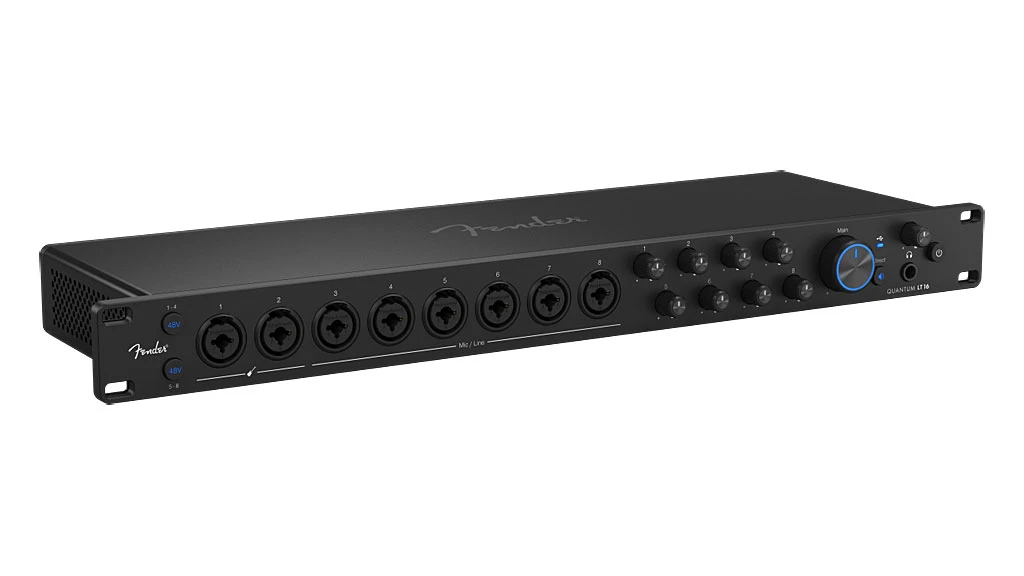
| Key Features
- Inputs: 8 XLR/TRS combo (mic/line), 2 instrument inputs, 8 rear TRS line inputs (14 line inputs total)
- Outputs: 2 balanced TRS main, 6 DC-coupled TRS line outputs, 1 stereo headphone
- Compatibility: macOS, Windows, iOS, iPadOS, Android
- Connectivity: USB-C (USB 2.0), external power supply included
- Resolution: 24-bit / 192 kHz
- Plus: Perpetual Fender Studio Pro license, 5-pin MIDI I/O, DC-coupled CV outputs, Standalone Mixer Mode, Mic Pre Mode
| Best for...
- Bands and drummers recording multi-mic sessions
- Electronic musicians with hardware synths and modular setups
- Project studios needing a scalable interface hub
- Hybrid producers bridging DAW and outboard gear
- Hybrid producers bridging DAW and outboard gear
| Not ideal for...
- Solo artists who only record one source at a timec
- Mobile recording setups requiring bus power
- Studios needing more than 16 simultaneous inputs
When Your Studio Outgrows Your Interface: LT 16 Overview
There comes a point in every producer’s journey where the two-input interface stops making sense. You want to mic a drum kit properly. Your synth collection needs more than one stereo pair. You’re tired of constantly repatching because your interface ran out of inputs three projects ago.
The Fender Quantum LT 16 addresses this exact moment. It’s the flagship of Fender’s LT series, and it represents a significant step up from the Fender Quantum LT 2 and Quantum LT 4 in both capability and purpose.
Where those smaller interfaces serve solo artists and duos, the LT 16 targets project studios, bands, and electronic musicians who need serious connectivity. Eight MAX-HD preamps provide enough channels to properly mic a drum kit with room to spare. Fourteen total line inputs accommodate hardware synths, external preamps, and outboard processors without compromise. DC-coupled outputs bridge your DAW to modular gear. MIDI I/O connects your hardware sequencers and drum machines.
Eight Preamps and Beyond: Features That Define the LT 16
The LT 16 shares DNA with its smaller siblings but adds capabilities that transform it from a recording interface into a studio command center. Here’s what sets it apart.
Eight MAX-HD Mic Preamps with 75 dB Gain
The same preamp technology from the LT 2 and LT 4, multiplied by eight. Each channel delivers 75 dB of transparent gain across a 20Hz–20kHz range.
- What It Means for You: Recording drums properly requires at least four mics—kick, snare, and a stereo overhead pair. Most drummers prefer six to eight: kick in, kick out, snare top, snare bottom, hi-hat, two overheads, and a room mic. The LT 16 handles all of this from a single interface. No need for external preamps or daisy-chained units. And with 75 dB of gain on every channel, ribbon mics on the overheads work without boosters.
Fourteen Total Line Inputs
Six front-panel combo jacks (which double as mic inputs 3-8) plus eight dedicated rear-panel TRS inputs. The rear inputs feature switchable +4 dBu / -10 dBV operation.
- What It Means for You: Your hardware synths finally have a permanent home. Connect your Prophet, your Moog, your drum machines—leave them patched and ready. The switchable levels accommodate both professional (+4 dBu) and consumer (-10 dBV) gear, so everything from your vintage Juno to your Eurorack output stage works correctly.
DC-Coupled Line Outputs
Six of the eight line outputs are DC-coupled, meaning they can send control voltage (CV) signals directly to compatible gear.
- What It Means for You: This bridges your DAW to the analog world in ways most interfaces can’t. Send LFOs, envelopes, and pitch sequences from your software directly to your modular synth’s CV inputs. Automate hardware parameters from your timeline. This feature alone justifies the LT 16 for electronic musicians who’ve been buying separate CV interfaces.
5-Pin MIDI I/O
Traditional DIN MIDI input and output connections for hardware integration.
- What It Means for You: Your hardware sequencers, drum machines, and vintage synths connect without USB adapters or separate MIDI interfaces. Sync your DAW to external clock sources, or drive hardware from your software timeline. One less box on your desk, one less potential point of failure.
Standalone Mic Pre Mode
The LT 16 can function as an 8-channel standalone microphone preamp without a computer connection.
- What It Means for You: Already own a larger interface or mixing console? The LT 16 becomes an 8-channel preamp expansion. Run the preamp outputs to your existing system’s line inputs. This extends the useful life of your investment—even if you upgrade your main interface later, the LT 16 remains valuable as a preamp bank.
Standalone Mixer Mode
Use the interface as a simple analog mixer without launching your DAW.
- What It Means for You: Rehearsals, live performances, classroom setups—situations where booting a computer adds friction. Plug in your sources, set your levels, and go. The interface remembers your last settings, making setup fast for recurring situations.
Fender-Designed Instrument Inputs
Two dedicated Hi-Z inputs voiced specifically for guitars and basses, carrying forward the same design from the LT 2 and LT 4.
- What It Means for You: Even with all this I/O, the LT 16 doesn’t forget that Fender built it. The instrument inputs preserve the dynamics and character of your playing—the same quality that makes the smaller models attractive to guitarists. Plug in a Strat or a Jazz Bass, and it sounds like it should.
Perpetual Fender Studio Pro License
Unlike the 6-month trial included with the LT 2 and LT 4, the LT 16 comes with a perpetual license for Fender Studio Pro—the rebranded Studio One Pro.
- What It Means for You: This is a full professional DAW, permanently yours, with exclusive Mustang Guitar and Rumble Bass amp plugins. No subscription required, no expiration date. At a ~$200 standalone value, it significantly offsets the LT 16’s price premium over the smaller models.
Fender Quantum LT 16 Specifications: Complete Reference
Before committing to a studio centerpiece, verify every spec matches your requirements. I’ve cross-referenced these details against manufacturer documentation and retailer listings.
| Feature | Specification | Practical Benefit |
|---|---|---|
| Simultaneous I/O | 16-in / 8-out | Record full bands while maintaining flexible monitoring |
| Mic Preamps | 8 MAX-HD with 75 dB gain | Enough channels for complete drum miking with headroom to spare |
| Combo Inputs | 8 XLR/TRS (front panel) | Accept mics, instruments, or line sources on channels 1-8 |
| Instrument Inputs | 2 dedicated Hi-Z (channels 1-2) | Fender-designed inputs preserve guitar and bass tone |
| Line Inputs | 14 total (6 front combo + 8 rear TRS) | Permanent connections for synths, outboard, and external preamps |
| Rear Line Levels | Switchable +4 dBu / -10 dBV | Accommodate both professional and consumer gear |
| Main Outputs | 2 balanced TRS | Connect studio monitors |
| Line Outputs | 6 DC-coupled TRS | Send CV to modular gear or route to outboard processors |
| Headphone Output | 1 stereo (1/4" TRS) | High-power amp for tracking |
| MIDI | 5-pin DIN In/Out | Connect hardware synths, sequencers, and drum machines |
| Resolution | 24-bit / 192 kHz | Professional recording quality |
| Phantom Power | 48V (switchable per channel pair) | Power condenser microphones |
| Connectivity | USB-C (USB 2.0) | Universal computer connection |
| Power | External supply (included) | Stable power for 8 preamps and extensive I/O |
| Compatibility | macOS, Windows, iOS, iPadOS, Android | Works across all major platforms |
| Software Included | Perpetual Fender Studio Pro | Full DAW with Mustang and Rumble plugins ($200 value) |
| Dimensions | 330 x 190 x 47 mm (13 x 7.5 x 1.9 in) | Half-rack width fits studio furniture |
| Weight | 2.2 kg (4.8 lbs) | Solid build for desktop use |
| Price | $499 USD | Competitive against 8-preamp interfaces |
Recording Full Sessions: Performance in Real Scenarios
The specs tell one story. Actual recording sessions tell another. Here’s how the LT 16 handles the workflows it was designed for.
Drum Recording: This is where eight preamps justify their existence. I tested a standard setup: kick (dynamic), snare top (dynamic), snare bottom (small condenser), hi-hat (small condenser), rack tom (dynamic), floor tom (dynamic), and stereo overheads (large condensers).
The MAX-HD preamps delivered consistent performance across all eight channels. No audible difference in noise floor or character between preamp 1 and preamp 8—something that matters when you’re blending multiple mics on a single source. The 75 dB gain proved useful on the overheads, where I used ribbon mics that typically need external boosters on lesser interfaces.
Phantom power switches in pairs (1-2, 3-4, etc.), which required some planning to avoid sending phantom to ribbon mics. A minor consideration, but worth noting for mixed-microphone sessions.
Hardware Synth Integration: The fourteen line inputs transformed my synth workflow. Previously, recording my Prophet and Moog required constant repatching through a two-input interface. With the LT 16, both synths stay connected alongside a drum machine and a Eurorack output module.
The switchable +4 / -10 dBV levels on the rear inputs handled level matching without external pads. The Eurorack outputs (typically hot) sat happily at +4 dBu, while the vintage Juno worked better at -10 dBV.
DC-Coupled CV Control: The DC-coupled outputs opened creative possibilities I hadn’t considered. Sending an LFO from my DAW to control a hardware filter’s cutoff—while simultaneously recording the synth’s audio output—created feedback loops between software and hardware that neither could achieve alone.
For modular users, this eliminates the need for a separate DC-coupled interface like the Expert Sleepers ES-8. The LT 16 handles CV duties alongside standard audio, consolidating two pieces of gear into one.
Band Tracking: Recording a four-piece band simultaneously—drums (4 mics), bass DI, guitar DI, and two vocals—used 8 of the 16 available inputs. The remaining inputs stayed patched to the keyboard player’s rig for overdubs.
The low-latency drivers performed well during tracking with amp simulation. The guitarist monitored through plugins without audible delay, though I still recommend direct monitoring for the most critical performances
Standalone Operation: Mixer Mode worked as expected for rehearsal situations—a simple way to get sound without involving a computer. More interesting was Mic Pre Mode, which I tested by routing the LT 16’s preamp outputs into a different interface.
This scenario matters for studios that already own a larger converter but need more preamps. The LT 16’s eight channels expanded my existing setup cleanly, and the MAX-HD preamps held their own against dedicated outboard units costing considerably more.
Build and Layout: Designed for the Desktop
The LT 16 follows a half-rack form factor—wide enough to accommodate all the I/O, shallow enough for desktop use without requiring rack mounting.
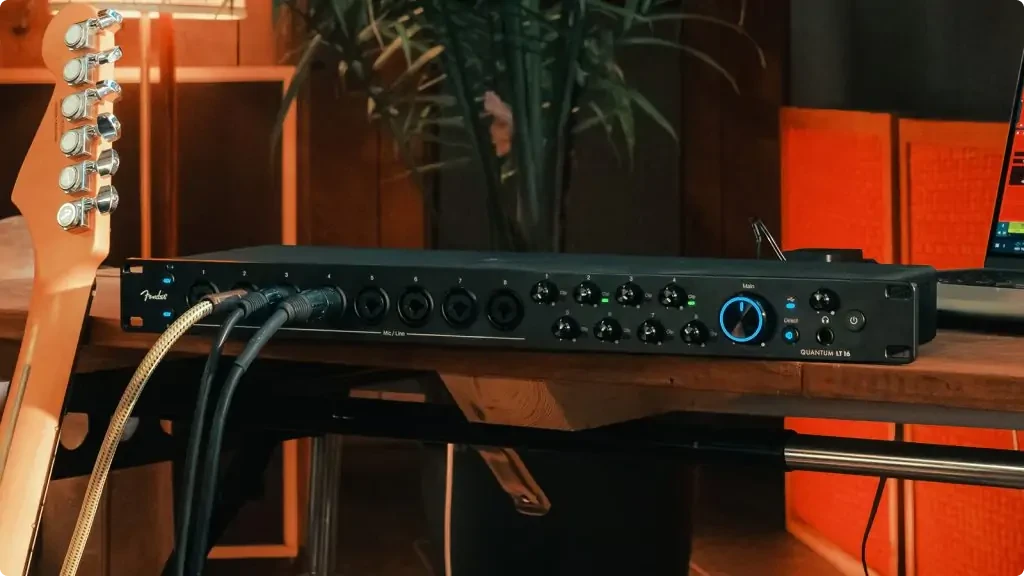
Front Panel
The layout prioritizes the most-accessed controls. Channels 1 and 2 feature dedicated instrument inputs alongside their combo jacks, with individual gain knobs. Channels 3-8 share the front panel with combo inputs and paired gain controls.
A main volume knob controls the monitor outputs, while a separate headphone volume provides independent level control. Status LEDs indicate phantom power, signal presence, and clipping—useful visual feedback during tracking.
The single headphone output may limit multi-performer tracking scenarios. For sessions requiring separate headphone mixes, an external headphone amp becomes necessary.
Rear Panel
The rear handles the permanent connections: eight TRS line inputs (with the +4/-10 dBV switches), eight line outputs (including the six DC-coupled pairs), USB-C port, MIDI I/O, and power input.
Balanced TRS main outputs connect to studio monitors. The additional line outputs enable external processing sends, alternate monitor pairs, or CV routing to modular gear.
Power Considerations: Unlike the bus-powered LT 2 and LT 4, the LT 16 requires its included external power supply. This makes sense—eight preamps plus extensive I/O demand more current than USB can reliably provide.
The trade-off is reduced portability. This interface belongs on a desk, not in a backpack. If you need mobile recording capability, consider the LT 4 for location work and the LT 16 for your main studio.
Setup Experience
Initial setup followed the same streamlined process as the smaller models. Universal Control handles driver installation and firmware updates, while My Fender access manages registration and the Fender Studio Pro license activation.
The software mixer in Universal Control becomes more valuable with 16 inputs to manage. Creating monitor mixes, setting up cue sends, and configuring loopback routing all happen within the app—controllable from desktop or mobile devices.
Building a Hybrid Studio Around the LT 16
The Quantum LT 16 isn’t just an interface—it’s designed to be the hub that connects your entire creative ecosystem. Here’s how to maximize its potential.
Creating a Hardware-Software Workflow: The combination of line inputs, DC-coupled outputs, and MIDI opens workflows that neither purely software nor purely hardware setups can match.
Consider this signal flow: your DAW sends MIDI to a hardware synth via the LT 16’s MIDI output. The synth’s audio returns through the line inputs for recording. Simultaneously, a software LFO sends CV through the DC-coupled outputs to modulate the synth’s filter. The result is a hybrid patch where software and hardware interact in real-time.
This kind of integration previously required multiple specialized devices. The LT 16 consolidates it into a single interface.
Expanding Over Time: The Standalone Mic Pre Mode future-proofs your purchase. If you eventually move to a higher-end converter or a mixing console with line inputs, the LT 16 transforms into a dedicated 8-channel preamp bank.
This makes the initial investment more defensible. You’re not buying an interface you’ll discard when you upgrade—you’re buying preamps that remain useful regardless of what else changes in your studio.
Optimizing for Low Latency: The custom drivers deliver responsive monitoring, but understanding your options helps optimize performance.
For tracking through plugins (amp sims, vocal effects), set your DAW’s buffer size low—128 or 256 samples on most systems. The LT 16’s drivers handle this without dropouts in my testing.
For mixing or playback-heavy sessions where latency doesn’t matter, increase the buffer to reduce CPU load. The flexibility to adjust based on the task keeps the interface useful across different workflow stages.
Managing Complex Sessions: With 16 inputs available, session organization becomes important. Name your tracks clearly. Color-code input groups (drums, synths, vocals). Create track templates for recurring setups—a drum recording template, a synth session template, etc.
Universal Control’s software mixer supports saving and recalling configurations. Use this for different session types so you’re not rebuilding your routing from scratch every time.
Final Verdict: Is the Quantum LT 16 Your Studio's Missing Piece?
The Fender Quantum LT 16 succeeds at its intended purpose: providing a complete studio hub for creators who’ve outgrown basic interfaces. Eight preamps handle full drum kits and ensemble recordings. Fourteen line inputs accommodate serious hardware collections. DC-coupled outputs and MIDI I/O bridge the DAW-hardware divide.
At about ~$500 it competes favorably with established options from Focusrite, PreSonus, and MOTU. The perpetual Fender Studio Pro license adds tangible value—especially compared to the 6-month trials included with the LT 2 and LT 4. For someone building a studio from scratch, the DAW alone offsets a significant portion of the price difference.
The limitations are predictable for this class of interface. External power means reduced portability. A single headphone output restricts multi-performer monitoring. No ADAT expansion caps growth at 16 inputs.
For guitarists and bassists specifically, the Fender-designed instrument inputs carry forward the same quality that makes the smaller LT models attractive. You don’t sacrifice guitar tone for expanded capability—the LT 16 handles both.
Who should buy the LT 16:
- Bands ready to record drums and full sessions properly
- Electronic musicians with hardware synths, modular gear, or both
- Project studios that need room to grow
- Anyone currently limited by a 2-4 channel interface
Who should consider the smaller models instead: Solo artists and duos who rarely need more than two simultaneous inputs
- Mobile recording setups requiring bus power
- Beginners who don’t yet need 16 channels
The Fender Quantum LT 16 represents a genuine step up in studio capability. For creators at the right stage of their journey, it’s not just an interface upgrade—it’s the foundation for everything that comes next.
8. FAQ
Can the Fender Quantum LT 16 record a full drum kit with separate tracks?
Yes. The LT 16 provides eight simultaneous mic preamps, which is enough to record kick, snare (top and bottom), hi-hat, two toms, and stereo overheads—each to its own track. All eight channels record simultaneously at up to 24-bit/192kHz. For larger drum setups requiring more than eight mics, you would need to use the additional line inputs with external preamps, since the LT 16 doesn’t offer ADAT expansion.
Does the Fender Quantum LT 16 work with Eurorack modular synthesizers?
Yes, and this is one of its standout features. Six of the eight line outputs are DC-coupled, meaning they can send control voltage (CV) signals directly to Eurorack modules and other CV-compatible gear. You can send LFOs, envelopes, gates, and pitch sequences from your DAW to control hardware parameters. The fourteen line inputs also accommodate Eurorack audio outputs at either +4 dBu or -10 dBV levels.
What's the difference between the Quantum LT 16 and the Quantum HD 2?
The LT 16 prioritizes input count with eight preamps and 16 total inputs, uses 24-bit conversion, and includes a perpetual Fender Studio Pro license. The HD 2 focuses on conversion quality with 32-bit resolution, includes ADAT and S/PDIF digital I/O for expansion, offers re-amp outputs, but only provides two preamps. Choose the LT 16 for multi-mic recording and synth integration; choose the HD Series for pristine conversion quality and digital expansion capability.
| Why Can You Trust Us

| ALSO REVIEWED